Biomarker Testing for Stage IV NSCLC
By identifying what may be causing your stage IV non-small cell lung cancer to grow and spread, biomarker testing could help you and your doctor determine which treatment options may help stop your cancer from growing or spreading.






What Is Biomarker Testing?
While certain biomarkers can be the “drivers” that cause stage IV non-small cell lung cancer to grow and spread, you may not learn about them from an initial diagnosis alone. Biomarker testing can help identify these drivers, giving you and your doctor a complete diagnosis to help inform treatment decisions for your specific type of cancer.
Guidelines recommend testing for PD-L1 and nine mutations, including EGFR, KRAS, ALK, ROS1, BRAF, NTRK 1/2/3, MET, RET, and HER2, to help determine appropriate treatment options.
Driver Mutation:
If you test positive for a specific driver mutation—such as an EGFR mutation—your healthcare team may prescribe a corresponding targeted therapy, a medication that helps target it.
PD-L1:
If biomarker testing reveals your cancer has cells with PD-L1, you may qualify for immunotherapy—a treatment that may help your immune system fight cancerous cells.
Biomarker testing may reveal positive results for both a driver mutation and a PD-L1 immune protein. In this scenario, it’s important that you work with your healthcare team to determine which treatment options may be appropriate to treat your specific type of lung cancer.
Overlap of EGFR Mutations and PD-L1 Expression1-4*
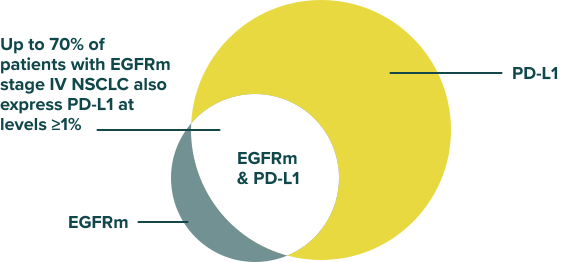
This venn diagram shows the overlap of EGFR mutations and PD-L1 expressions in stage IV NSCLC patients. The venn diagram shows a larger circle that represents those with PD-L1. The smaller circle represents those with EGFRm. The overlap in the two circles represents the 70% of patients with a positive EGFR mutation and stage IV NSCLC that also express PD-L1 at greater than or equal to 1%.
*Mazieres et al was a multicenter, international, retrospective study of 551 patients receiving ICI monotherapy for advanced NSCLC with at least one oncogenic driver alteration. 125 patients had an EGFR mutation.1 D'Incecco et al was a multicenter, retrospective, Italian study that assessed PD-L1 expression in 125 patients with mNSCLC and EGFR mutations, ALK translocations, or KRAS mutations. 56 patients had an EGFR mutation.2 Dietel et al was a multicenter, international, retrospective study that examined PD-L1 expression in 2368 tumor samples with histologically confirmed stage IIIB/IV primary NSCLC as classified by AJCC 7th edition. 448 patients had an EGFR mutation.3 Brown et al analyzed PD-L1 expression in 231 samples of untreated EGFR-mutated advanced NSCLC from the FLAURA trial of osimertinib.4
Two Ways to Test for Biomarkers in Stage IV Non-Small Cell Lung Cancer
Your doctor will test your lung cancer for biomarkers by sending tissue or a blood sample to a lab. Results take time, but they may help your doctor understand more about your specific type of cancer.
- 1.Your doctor may also consider complementary tissue and liquid biopsy testing (at the same time) to test for biomarkers.
- 2.If tissue is minimal or unavailable, your doctor may test for biomarkers through a liquid blood biopsy.



Biomarker Testing May Help Determine the Appropriate Treatment Plan
Biomarker test results can reveal specific information about your type of stage IV non-small cell lung cancer. This may help you and your healthcare team determine which treatment options may work for you.
References
- 1 Mazieres J, Drilon A, Lusque A, et al. Immune checkpoint inhibitors for patients with advanced lung cancer and oncogenic driver alterations: results from the IMMUNOTARGET registry. Ann Oncol. 2019;30(8):1321-1328. [Article and Supplementary Appendix]
- 2 D’Incecco A, Andreozzi M, Ludovini V, et al. PD-1 and PD-L1 expression in molecularly selected non-small-cell lung cancer patients. Br J Cancer. 2015;112(1):95-102.
- 3 Dietel M, Savelov N, Salanova R, et al. Real-world prevalence of programmed death ligand 1 expression in locally advanced or metastatic non-small-cell lung cancer: the global, multicenter EXPRESS study. Lung Cancer. 2019;134:174-179.
- 4Brown H, Vansteenkiste J, Nakagawa K, et al. Programmed cell death ligand 1 expression in untreated EGFR mutated advanced NSCLC and response to Osimertinib versus comparator in FLAURA. J Thorac Oncol. 2020;15(1):138-143.