What Is Biomarker Testing for Early-Stage NSCLC?
Early-stage NSCLC is sometimes called “resectable” because cancerous tissue is typically removed (or resected) through surgery. Biomarker testing can be performed on this resected tissue. However, even after a successful surgery, NSCLC may return. This is called a disease recurrence. There are treatment options available that may help prevent disease recurrence, so talk to your doctors and healthcare team about biomarker testing results and what treatment options may be appropriate for your specific type of lung cancer.






What Is Biomarker Testing?
Biomarker testing can reveal mutations (called biomarkers) present in your cancer. Certain biomarkers can be the “drivers” that cause NSCLC to grow and spread. Guidelines recommend testing for EGFR mutations in patients with stage IB-III NSCLC to help your doctor with treatment decisions after surgery. Guidelines also recommend testing for PD-L1 in certain patients with stage II-IIIA disease. Your doctor can talk to you about the stage of your disease and which tests are appropriate.
EGFR:
Epidermal growth factor receptor (EGFR) is a protein found in healthy cells. When cancer cells test positive for EGFR mutations, it could mean that changes in the cell DNA may be driving the cancer to grow and spread.
PD-L1:
Unlike driver mutations, PD-L1 is an immune protein found in varying amounts that may be preventing your immune system from fighting off cancerous cells.
Biomarker testing may reveal positive results for both a driver mutation and a PD-L1 immune protein. In this scenario, it’s important that you work with your healthcare team to determine which treatment options are appropriate to treat your specific type of lung cancer.
Patients with stage IB-III resectable EGFRm NSCLC can also express PD-L11
Overlap of EGFR Mutations and PD-L1 Expression1
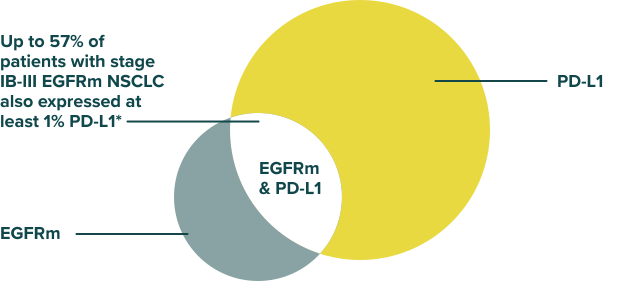
This venn diagram shows the overlap of EGFR mutation and PD-L1 expression in early-stage NSCLC patients. This venn diagram shows a larger circle that represents the patients with PD-L1 expression overlapping with a smaller circle labeled EGFRm. When the circles intersect, EGFRm & PD-L1 are both represented.
*EGFR mutation status and PD-L1 expression overlap was examined in a retrospective analysis of 319 patients with EGFRm NSCLC across all stages. EGFR mutations included exon 19 deletions (n=145), exon 21 L858R mutations (n=121), exon 19 nondeletions (n=26), exon 21 non-L858R mutations (n=3), exon 18 mutations (n=12), and exon 20 mutations (n=8). One patient had both exon 18 and exon 20 mutations and 3 patients had other mutations. PD-L1 expression ≥1% was observed in 86 out of 150 patients with stage IB-III EGFRm NSCLC.1
When Can You Get Biomarker Testing?
Biomarker testing can occur before surgery, through a pre-surgical biopsy, or after surgery by testing the surgically resected tissue if you are a good candidate for tumor removal. It can also be performed whether or not you are undergoing chemotherapy. If you’ve had surgery but are not sure if you’ve had biomarker testing, ask your healthcare team. The tissue removed may still be available for testing.



Biomarker Testing Can Help Your Healthcare Team Treat Your Specific Type of Cancer
Biomarker testing may detect cell proteins that could be causing your lung cancer to grow and spread. For early-stage patients, these tests may be done on a biopsy sample, or the tissue removed during surgery, to determine if the cancer cells have an EGFR driver mutation or PD-L1 immune protein.
Guidelines recommend testing for EGFR mutations in patients with stage IB-III NSCLC to help your doctor with treatment decisions after surgery. Guidelines also recommend testing for PD-L1 in certain patients with stage II-IIIA disease. Your doctor can talk to you about the stage of your disease and which tests are appropriate.
Up to 57% of patients with early-stage NSCLC and a positive EGFR mutation also express at least 1% PD-L1.1 If you test positive for both a driver mutation and PD-L1, it is important that you work with your healthcare team to determine your appropriate treatment options.
Upon receiving biomarker testing, have a conversation with your doctor to review your test results together and determine your appropriate path forward for treatment.
Reference
- 1 Cho JH, Zhou W, Choi Y-L, et al. Retrospective molecular epidemiology study of PD-L1 expression in patients with EGFR-mutant non-small cell lung cancer. Cancer Res Treat. 2018;50(1):95-102.